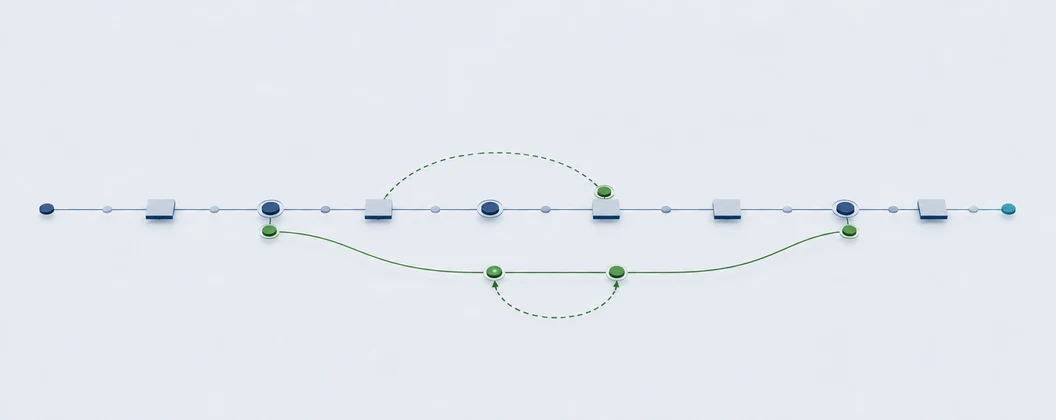
The reassuring completeness of a process map
Formal process documentation creates order. Activities have names, decisions have branches and handovers appear to connect one role with the next. A current flowchart or procedure can therefore give managers, auditors and project teams confidence that the organisation understands how work moves.
Everyday execution is usually less orderly. Employees clarify incomplete information through informal conversations, change the sequence of activities, maintain personal checklists and use temporary workarounds to protect delivery. Experienced people know which approval can wait, which data cannot be trusted and whom to contact when the official route stops working.
None of this necessarily appears on the official process map. The document may be internally consistent while the real process depends on a second, largely invisible operating system.
Operational reality changes faster than documentation
Processes evolve whenever demand, systems, staffing, regulation, equipment or customer expectations change. Some adjustments are deliberate improvements. Others begin as temporary responses to pressure. If they work well enough, they become normal practice even though no one formally decides to redesign the process.
Documentation follows a different rhythm. It may be reviewed on a schedule, before an audit or when a project formally changes scope. Between those moments, small operational changes accumulate. The gap between prescribed work and actual work grows one reasonable adjustment at a time.
Compliance-oriented maintenance can make this worse. The document is treated as evidence that a procedure exists rather than as a management model that must be tested against execution. Its formatting and approval status remain current while its operational assumptions become obsolete.
A process map is a model of reality, not reality itself. Improvement should begin by validating the model against real work.
The invisible process lives in people
The difference is often most visible in handovers and exceptions. Standard activities may follow the documented sequence, but unusual orders, missing data, machine limitations or conflicting priorities require judgement. The knowledge needed to keep work moving is stored in relationships and experience rather than in standard work.
This is not evidence that employees are careless or resistant to procedure. Informal practices may be the mechanism that compensates for weaknesses in the formal design. Removing them without understanding their function can make the process less reliable.
It also creates dependency. New employees learn the real workflow from colleagues rather than documentation. If an experienced person is absent, the formal process may appear intact while critical coordination disappears. What looks like an individual skills gap is often a knowledge-transfer failure built into the process.
Why this matters before improvement or automation
An improvement initiative based only on formal documentation targets the process the organisation believes it performs. Analysis may remove a step that exists only on paper while leaving untouched the informal activity that consumes time. A root-cause analysis may overlook a dependency because no approved diagram shows it.
Automation raises the stakes. Software implements explicit rules. It cannot reproduce an undocumented conversation, an experienced judgement or a manual check unless those elements are first discovered and deliberately designed. Automating the documented workflow can therefore remove the unofficial coordination that kept work moving.
Management decisions are affected as well. Capacity, staffing, risk and performance estimates derived from an inaccurate model will inherit its omissions. The better the diagram looks, the easier it may be to trust the wrong representation.
Automating the process on paper
An organisation prepares to automate an approval process. Its map shows a complete request moving from an operational team to a manager and then to a specialist reviewer. The proposed system mirrors those steps and removes email from the workflow.
Observation reveals that requests are rarely complete. An experienced coordinator checks them informally, contacts several people for missing information, changes their order according to operational risk and resolves common exceptions before formal submission. This work is absent from the map because the coordinator's role developed gradually.
The first automated design removes the coordinator's informal intervention without replacing its function. Incomplete requests now enter the formal queue, rework increases and approvals slow down. The technology did what the documented process required; the documented process did not describe what made the operation function.
Validate before redesigning
Validation does not require rejecting documentation or treating every deviation as correct. It requires comparing the model with evidence: observation, system records, employee accounts, exceptions, waiting points and real handovers.
Before redesigning a process, ask:
- Is this how work is officially described or how it is actually performed?
- Where do employees deviate from documented procedures?
- Which activities exist because the formal process no longer fits reality?
- Which handovers depend on personal knowledge rather than documented rules?
- If one experienced employee were absent tomorrow, would the process still function as expected?
The differences are diagnostic information. They show where the formal design is incomplete, where useful practice should be incorporated and where operational risk is being carried invisibly.