Pressure is easiest to see where work stops
Queues, overloaded workstations and delayed orders are hard to ignore. They create visible pressure, so improvement activity naturally concentrates there. Additional people are assigned, overtime is approved, equipment is upgraded or local working methods are changed.
The response seems logical: if work accumulates before one station, that station must lack capacity. Sometimes it does. But accumulation shows where inflow and outflow have become unequal; it does not by itself explain why.
A workstation may receive irregular batches, defective material, incomplete information or priorities that change faster than it can stabilise. The queue appears at that location because it is where the system can no longer absorb variation generated elsewhere.
Flow transfers instability
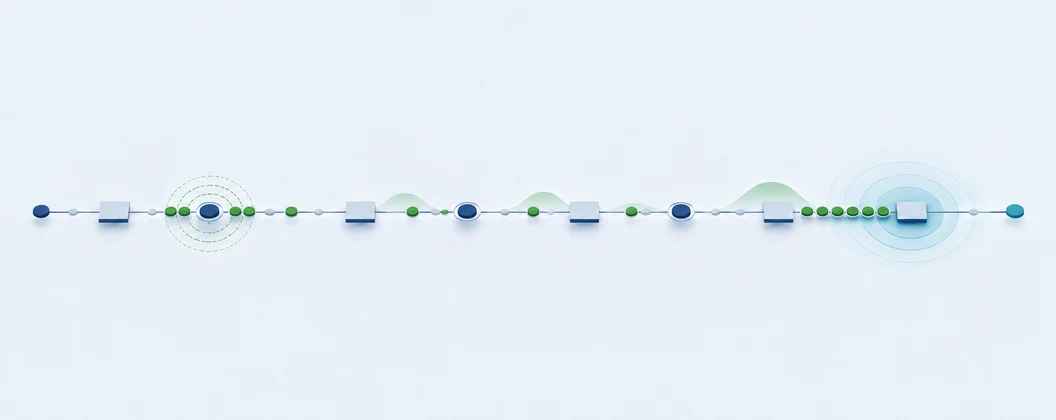
Flow is a property of the connected system, not of an isolated workstation. A delay in material release changes arrivals downstream. Quality defects create rework and unpredictable demand. Long changeovers encourage large batches, which alternate between starvation and overload. Scheduling decisions can push urgent work into the same path at the same time.
Each event may originate at a different point, but its effects travel. By the time the loss becomes visible, several causes may have combined. The visible station is often the first place without enough buffer, flexibility or time to hide them.
A bottleneck is often the messenger, not the cause. The place that exposes a constraint may not be the place that creates it.
This is why observation alone can be misleading. Seeing a long queue identifies a relevant point in the system, but not necessarily the mechanism that produced it.
Local optimisation can move the problem
When teams are measured by local utilisation or output, each area has a reason to optimise itself. An upstream station produces larger batches to reduce its unit time. A downstream station adds capacity to clear a queue. Both may report better local performance while total throughput remains unchanged.
Increasing capacity at the visible bottleneck can temporarily reduce accumulation. If the underlying release rules, variability or quality losses remain, pressure soon appears at the next stage. The constraint has moved, but the system has not become more capable.
This produces a discouraging pattern. Investment is completed, local indicators improve and delivery performance does not. Management concludes that the intervention failed, when the intervention may have solved the local symptom exactly as designed.
The busy station that absorbed variability
Work accumulates before a final assembly station. Its operators are continuously busy, overtime is common and delayed orders are visible there. The organisation adds another operator and purchases supporting equipment.
The queue briefly falls, then grows before testing. End-to-end observation shows that upstream quality defects create rework, batch-release rules produce irregular arrivals and the schedule changes several times per shift. Final assembly had been absorbing this instability and making it visible.
More assembly capacity was not useless, but it could not remove the dominant loss. The useful intervention begins upstream: stabilising quality, changing release logic and governing priorities. The original bottleneck was evidence about the system, not a complete diagnosis.
Find where instability begins
A sustainable diagnosis follows work across the full path. It compares demand, actual arrival patterns, queues, defects, interruptions, cycle times, release rules and decision points. It asks not only where work waits, but what conditions cause it to arrive in that form.
Before increasing local capacity, ask:
- Where does the flow first become unstable?
- Is this workstation creating the queue or receiving it?
- Which upstream activities influence the observed bottleneck?
- Would increasing local capacity improve total throughput?
- If this bottleneck disappeared tomorrow, where would the next constraint emerge?
The final question matters because every system has limits. The aim is not to pretend that constraints can disappear permanently. It is to locate the current governing constraint, understand what creates it and decide whether changing it will improve the outcome of the whole system.